


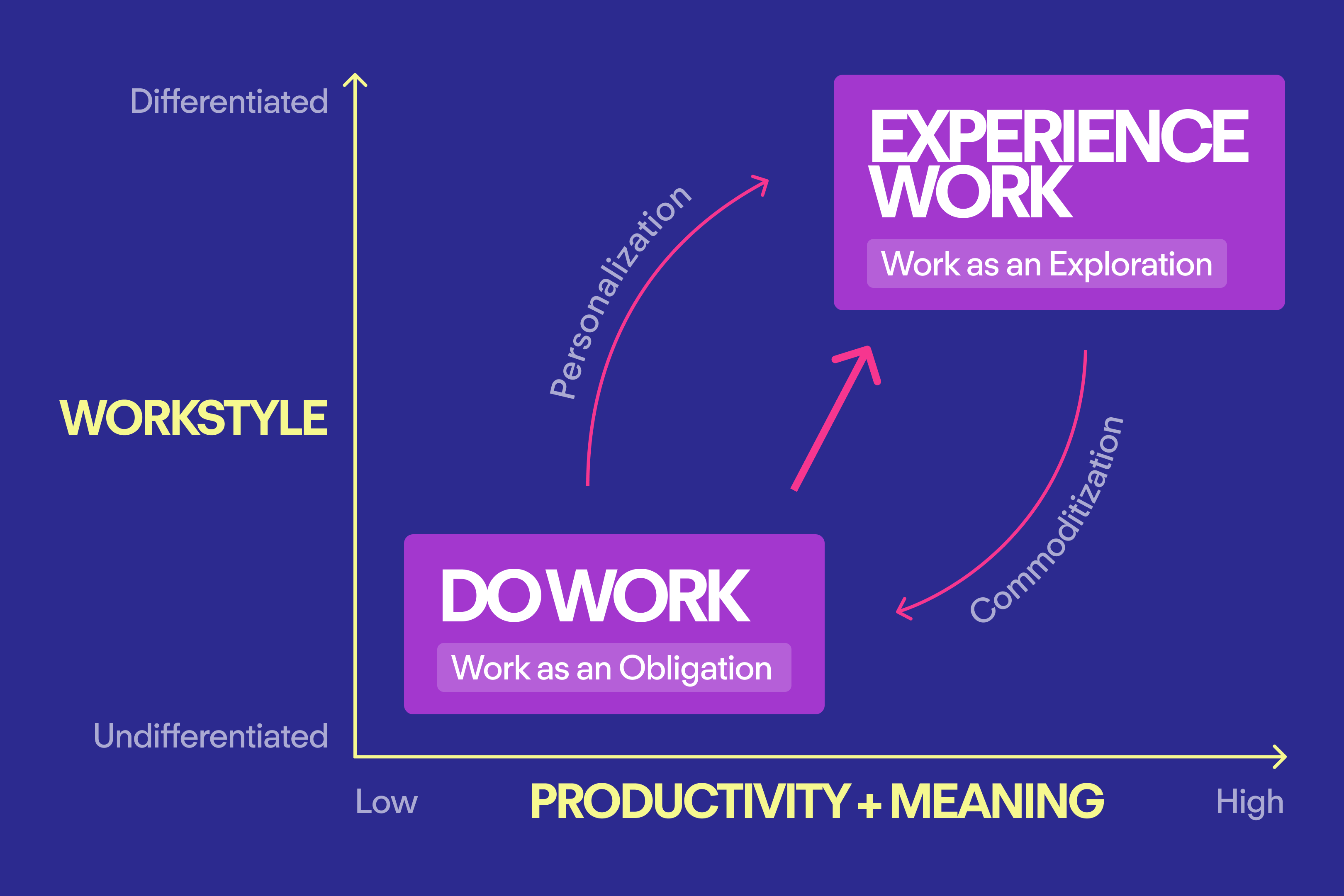
In recent years, one of the most significant trends in business has been personalization.
Thanks to digital technologies and the growing availability of data on people’s behaviors and preferences, companies have been able to personalize products and experiences.
Everything is chosen, selected, and designed “just for you.”
Everything, except for the organization of work.
While companies often offer the highest level of personalization to their customers, internally, they still operate in a completely standardized way. The same processes, the same policies, the same workflows, regardless of individual differences and preferences.
The Progression of Productivity
What does personalizing the work experience really mean?
It means moving away from pre-set, one-size-fits-all processes and workflows and embracing flexible, adaptable methods that can cater to each person’s unique needs and inclinations. It’s about giving people the freedom to choose where, how, and with which tools they work.
This approach doesn’t just improve comfort. It enhances effectiveness and productivity as well.
It was 1998 when Pine and Gilmore wrote Welcome to the Experience Economy. They explain how personalizing a product can turn it from a simple item into a service, and from a service into an experience. The more personalized a product is, the greater its value becomes, and we can charge more for it. An experience is the highest level a product can reach in terms of personalization, allowing it to achieve its maximum perceived value.
What would happen if we applied the principles of the Experience Economy to work? By progressively increasing the level of personalization in the way we work, we could transform standardized tasks—tasks reduced to mere commodities, done only out of necessity—into meaningful and transformative work experiences, generating greater value both for employees and the organization.
In other words, when an organization creates personalized work experiences tailored to the specific needs of its employees—rather than applying the same rules and policies for everyone—it can increase both productivity and the value it generates.
Start with the Team, Focus on Results
So, how do we implement such a transformation?
Start with the smallest unit: the team.
Then prioritize the outcome: the effectiveness and quality of the output matter more than processes and tools.
The team can decide autonomously how to work: remotely or in the office, scheduling meetings or working asynchronously, choosing tools, methods, and strategies. They can adjust their approach depending on the project and the goals.
A team is a small, agile unit that can experiment and adapt quickly. Moreover, a team responsible for a product or service is close to customers and the dynamics of the market, so it is in the best position to tailor its workflow to deliver results.
Company OS
So, is it a free-for-all? Does everyone just do whatever they want, and we meet at the Christmas party?
Of course not.
The more flexibility and autonomy there is, the more organizations need to be able to guide, motivate, and ensure alignment in the work.
To do this, they need to implement an operating system: a platform that facilitates the exchange, tracking, and access to information.
This way, even while working autonomously, everyone can contribute to the organization’s goals, collaborate with other teams, and build on what has already been accomplished. They will also follow the company’s core values and have equal access to resources and opportunities.
Haier, the Chinese company that transformed its monolithic structure into an ecosystem of autonomous, independent micro-enterprises, built a digital platform to circulate internal information and exchange resources.
This platform allows each team to organize their work freely, guided only by the goal of delivering the best possible product to customers.
From this perspective, personalization is not just a strategy for talent acquisition or retention. It’s a business strategy that, in the coming years, could become essential for driving innovation and staying competitive.
In Practice
For You
Build your own workstyle. Reflect on your work habits, your preferred modes of interaction and learning, what you love doing, and what you dislike. Learn to ask yourself the right questions, then write down or note the answers so you can communicate them easily to others. This way, it will be easier for those working with you to adapt and implement personalized strategies that fit your needs.
What’s important is to emphasize that your workstyle isn’t a whim—it’s a way to express your talent in the best way possible, to set yourself up to do what you do best. In the future, the uniqueness of your workstyle could become your greatest strength, a distinguishing trait that sets you apart from other professionals and from the tools that will learn to do your job.
For Your Organization
Find the differences. As tools become more and more standardized, more powerful, and capable of automating tasks, what will truly make the difference isn’t so much the ability of a person to perform a task or follow a workflow.
What will matter more is the person themselves: the way they think, how they use the tools, but also their personal history, their unique experiences, and the things they have lived through that have shaped their one-of-a-kind approach to work.
For organizations, it will become increasingly important to recognize and value this uniqueness, which means creating room for diverse work methods.